Every product team has the same folder somewhere — a spreadsheet, a slide deck, a shared doc — titled something like “Competitor Landscape.” And every team knows the same uncomfortable truth about it: it was accurate the week someone built it, and it has been quietly going stale ever since.
Competitors ship new features. They change their pricing pages. New players show up that nobody on the team has even heard of yet. Keeping a real, current picture of the market means someone has to repeatedly visit a dozen different websites, compare what changed, and rewrite the summary — a job that’s easy to postpone and hard to do well by hand.
The Competitor Analysis Agent takes that job off your plate. Point it at your product, and it goes out, finds who you’re actually competing with today, reads their live websites, and comes back with a structured, sourced picture of where you stand.
Why Manual Competitive Research Falls Behind
Doing competitive research properly means answering a moving target of questions: Who else is out there right now? What do they charge? What have they built that we haven’t? What have we built that they haven’t caught up to yet?
None of these questions have a one-time answer. They need to be asked again and again, and each time, someone has to open browser tabs, click through pricing pages, and try to reconstruct an honest comparison — often from memory or from whatever was written down last quarter. The result is that most teams aren’t working from wrong information; they’re working from outdated information, which can be just as costly.
Meet the Competitor Analysis Agent
The Competitor Analysis Agent is built to do this research the way a very thorough analyst would — except it doesn’t get tired, it doesn’t skip the pricing page, and it can do it again next week without complaint.
Instead of relying on whatever the underlying AI model already “knows” about your market — which can be months or years out of date — the agent goes out and reads competitor websites live, every time you run it. That distinction matters: it’s the difference between a guess and a citation.
How the Agent Builds Your Competitive Picture
Click Run Analysis, and the agent works through a multi-stage pipeline behind the scenes:
- Discovery — it searches the live web for companies that genuinely compete with your product, rather than pulling from a static, pre-built list.
- Validation — it uses AI to review the candidates and filters out anything that isn’t a real, direct competitor, so you’re not comparing yourself to unrelated tools.
- Live scraping — it actually visits each competitor’s homepage, pricing page, and features page to capture what’s there right now.
- Analysis — the agent lines up your product’s features against each competitor’s and flags where the gaps are — in both directions.
- Pricing extraction — wherever pricing is publicly listed, the agent pulls out structured pricing tiers instead of leaving you to copy-paste numbers by hand.
- Insights — everything is distilled into a ranked list of feature gaps, a strategic summary, and a Persistent Gap registry that keeps track of which gaps keep showing up across multiple runs over time.
What You Get: Four Views into Your Market
Once the analysis finishes, the results aren’t dumped into one long report — they’re organized into four focused views:
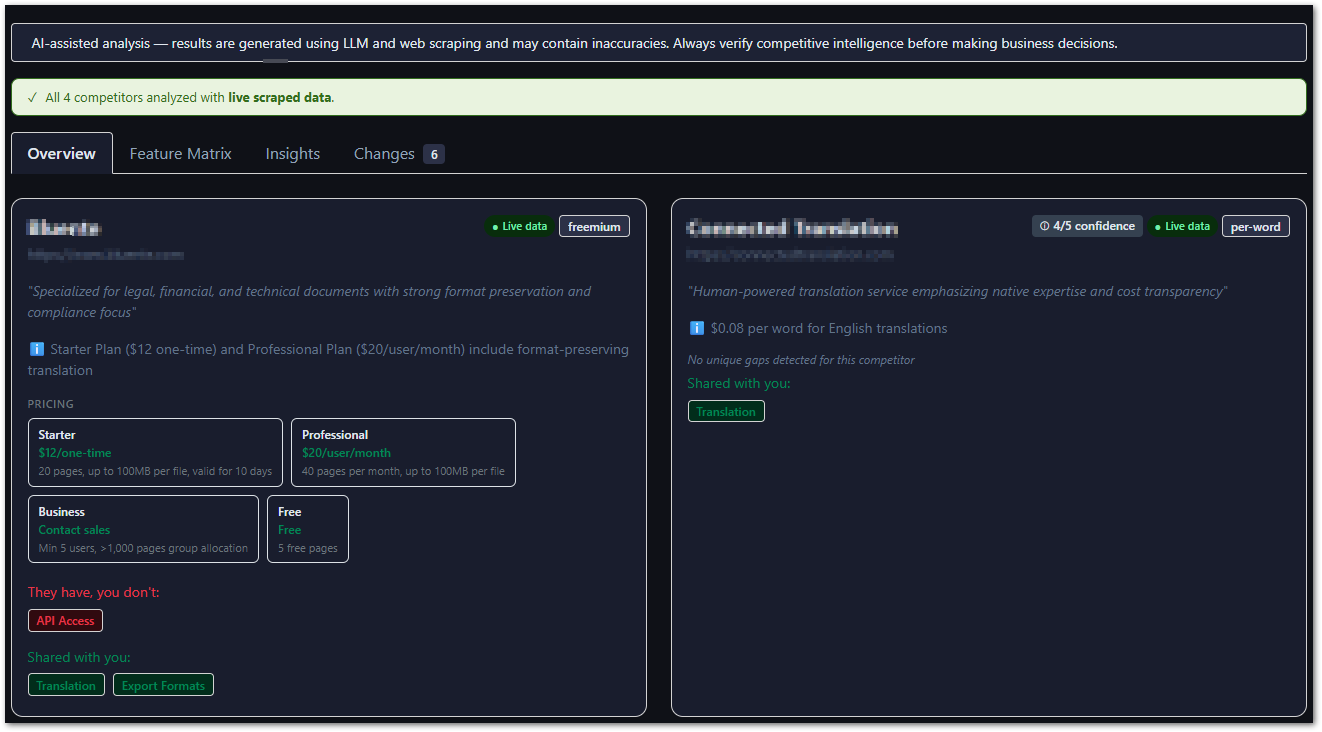
- Overview — a card for every competitor, showing their positioning and pricing alongside a clear breakdown of what they offer that you don’t, what you both share, and what’s uniquely yours. Each finding is tagged with whether it came from a live scrape or general knowledge, so you can judge how much weight to put on it.
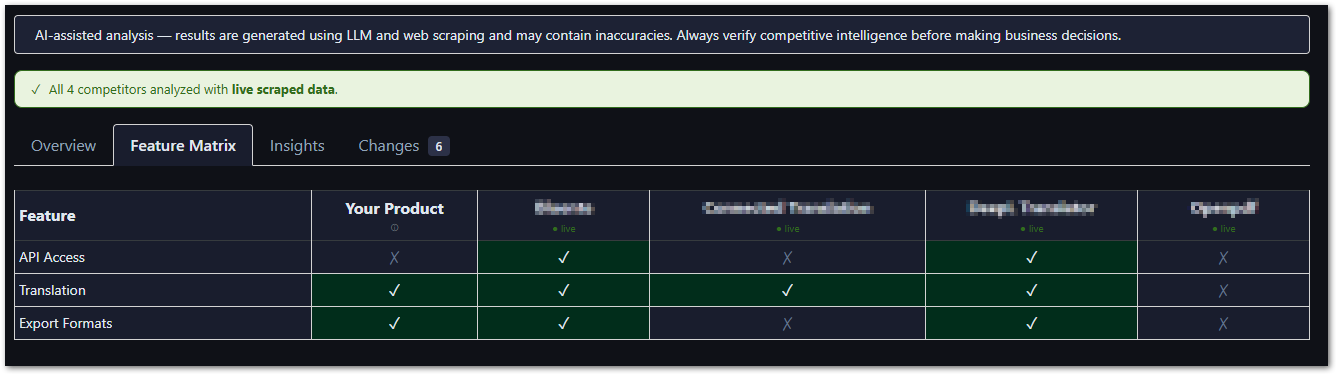
- Feature Matrix — a side-by-side table across every competitor and feature area, built for spotting patterns at a glance rather than reading paragraph after paragraph.
- Insights — a short strategic summary, a look at where your product stands out, and a ranked list of feature gaps by priority and by how many competitors already have them.
- Changes — a record of what’s shifted since your last analysis, so you’re tracking movement in the market instead of starting from a blank page every time.
Who This Agent Is Built For
- Product managers who need a competitive landscape that reflects this month, not last year.
- Founders and team leads deciding what to build next based on real, sourced feature gaps instead of a hunch.
- Marketing and sales teams who need current, defensible pricing and positioning comparisons.
- Anyone who owns a product and wants an honest answer to “where do we actually stand against the market?”
Getting Started Takes Minutes
- Log in and add your product — give it a name, a URL, and a short description. The more specific the description, the sharper the analysis.
- Optionally, list any competitors you already know about and tag your product’s own features to seed the comparison.
- Click Run Analysis and let the agent do the research — it typically wraps up in a few minutes.
- Review the results across the Overview, Feature Matrix, Insights, and Changes tabs.
- Re-run the analysis whenever you like, or turn on weekly auto re-analysis and let your competitive picture stay current on its own.
Research That Doesn’t Get Stale
The whole point of the Competitor Analysis Agent is that it doesn’t produce a snapshot you’ll have to redo from scratch in three months — it produces a picture you can refresh with a single click, with every finding traceable back to its source. That’s a meaningfully different way to stay competitive than another spreadsheet nobody wants to update.
Give it your product URL, and let it go find out what everyone else is doing.